
Buying Guide: Internal end caps
Les points abordés
Different names for the same end cap
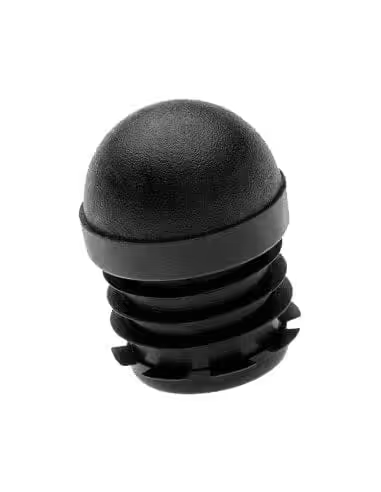
These end caps are referred to interchangeably as internal end caps, ribbed end caps, lamellar end caps, push-in end caps or even insertable end caps. What they all have in common is that they are installed inside a tube, profile, or leg, with one part inserted into the tube and another part (the glide) remaining on the outside. On finishing end caps, this external part can serve to protect people from potential injury or protect the tube from the entry of moisture, insects, or dust. For leg end caps, it can also serve as a load-bearing glide when used as a foot for chairs, tables, desks, etc.
See all our internal end caps
End caps in various shapes: round, square, rectangular, oval
Insertable end caps are available in several shapes: round end caps, square end caps, rectangular end caps, and oval end caps. Regardless of the shape of the leg or tube end cap, they are designed with retaining ribs. Furthermore, depending on the model, you will find leg end caps and finishing end caps.
Installation into a tube or profile
Internal end caps are force-fitted or adjusted using a plastic mallet into the leg or tube they are being installed on. The pressure exerted by the inside of the tube on the ribs of the end cap ensures a lasting fit. The part of the plastic end cap that remains outside the tube or leg “rests” on the end of the tube. With accurate measurements, this external part sits perfectly flush with the outer walls of the tube or leg. There should be no protrusion or recession. This requires precise measurement.
Measure the tube or leg properly to find the right end cap
First of all, to measure the dimensions of a tube or leg, whether round, square, or rectangular, it is recommended to use a caliper. This instrument will very simply give you an accurate measurement of the external and internal dimensions. One of the best brands in this field is Mitutoyo (available on Amazon here) or Facom (also available on Amazon here).
In our range of internal end caps, choose the end cap with the External diameter that corresponds exactly to the External diameter measured on your tube. Once you have found the end cap(s) with an External diameter that matches that of your tube, ensure that the Internal diameter of your tube falls within the range of Internal diameters mentioned on the end cap product page.
Dimensions of our end caps: always take the mentioned external dimensions into account
In the technical data mentioned on our product pages, you will find two important dimensions: the External dimension (diameter for round tubes or section for other shapes) and the Internal dimension (diameter for round tubes or section for other shapes).
For example, for a round tube with a measured External diameter of 25mm, choose an end cap with an External diameter of exactly 25mm. The External diameter of the end cap must be the same as the External diameter of your tube.
Tube or leg wall thickness
Once you have found the end cap with the correct External dimension, check that the Internal dimensions are suitable. Indeed, the walls of the tube or leg will reduce the space available for inserting the end cap. These walls will act to ensure sufficient pressure on the end cap’s ribs, which will deform to guarantee a good hold.
For example, for a round tube with a measured Internal diameter of 20mm, choose an end cap with an Internal diameter of 18-20mm or 19-21mm, for instance. Your tube’s Internal diameter must be within this range to guarantee a perfect fit.
To help you, you can use our selection tool here by adjusting the filters on the left side of the page.
In any case, if you have any doubts or need advice on finding the right end cap, you can contact us by email (in the Contact section here) or by phone at 09 81 17 41 57 (Monday to Friday, 9 am to 6 pm). We will recommend the end cap or plug that will suit your particular situation.


